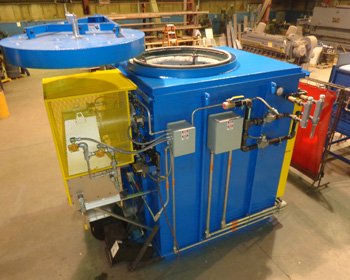
Car Bottom Furnaces

car bottom furnaces

Electrically Heated or Gas Fired

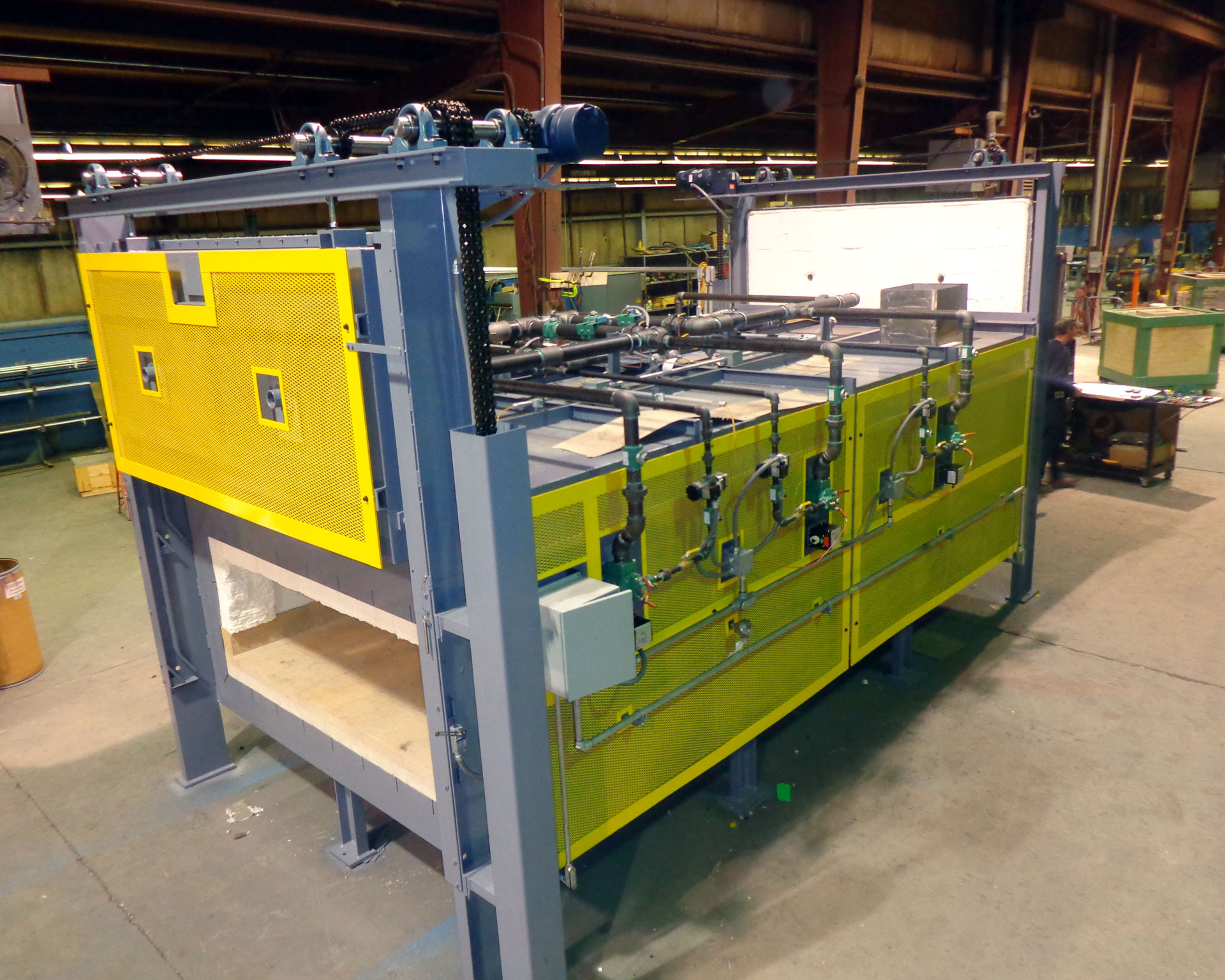
car bottom furnacesUpton manufactures car bottom furnaces in either electric or gas fired heating systems. The design of the heating systems provide for shielding of the loads from the detrimental effects of direct radiant heat or flame impingement while promoting efficient uniform heating of the loads.

Electric Heating Systems

Electric furnaces employ various styles of resistance type electric heaters to maintain the integrity of the furnace atmosphere and thermal efficiencies. Heaters can be supplied as either standard open resistance wire type, or bayonet/radiant tube style based on the specific furnace application, intended atmosphere and/or customer preference. SCR power controllers with control panel door mounted diagnostics displays are standard for Upton furnaces, with optional PLC and PC systems integration available. Heating systems are factory prewired to meet NEC and NFPA standards where applicable, and all equipment is factory tested prior to shipment.

Gas Firing Systems

Gas fired furnaces employ either direct gas firing or radiant tube style gas firing burners to maintain the integrity of the furnace atmosphere. Sealed burner systems can be supplied as either standard tube firing or single end recuperative type based upon customer preference. Solid state flame supervision systems with panel door mounted diagnostics displays are standard for Upton furnaces, with optional PLC and PC systems integration available. Combustions systems are factory prepiped to meet FM, IRI, and NFPA standards where applicable, and all equipment is factory tested prior to shipment.

Thermal Recirculation Systems

Upton furnaces utilize alloy construction cartridge type fans for recirculation of the furnace atmospheres, promoting close tolerance temperature uniformities. Recirculation fans are located within a stainless steel plenum positioned in the top of the furnace heating chamber, integrated with the gas firing or electric heating system, to eliminate potential of direct heating of the workloads. Lateral sidewall ductwork is employed for introduction of the furnace atmosphere into the workzone beneath the workload, with recirculation and redistribution through the fan plenum inlet.

Triple Seal Door Designs

The design of the furnace door is to provide for a triple-seal of ceramic fiber to ceramic fiber, fiber to furnace steel faceplate, and a gasketed perimeter seal around the furnace door. This triple-seal design, combined with our pneumatically operated, automatic clamping devices, create a positive pressured door seal, minimizing heat loss while maintaining atmosphere integrity. All door opening systems are designed to move the door away from the faceplate to eliminate abrasion of the refractories during operation.

“Coldcar” Type Furnace Design

Upton car bottom furnaces employ our “ColdCar” loading hearth design which only requires heating of the work load and loading hearth, rather than the entire structural car. The “ColdCar” is designed with pneumatically operated seals positively locating the car to the furnace structure minimizing heat loss while maintaining atmosphere integrity.

Custom Designed & Engineered

Our in-house engineering and manufacturing allows Upton to custom design furnaces and systems to a customers process and specification requirements, rather than attempting to provide to you standard pre-design equipment, as some of our competitors would attempt to do. Follow-up technical services are available for all Upton thermal process systems.

Our Engineered Thermal Solutions will allow for flexibility in your manufacturing productivity.

Box Furnaces

box furnaces

Electrically Heated or Gas Fired

box furnacesUpton manufactures batch type furnaces in either electric or gas fired heating systems. The design of the heating systems provide for shielding of the loads from the detrimental effects of direct radiant heat or flame impingement while promoting efficient uniform heating of the loads.

Electric Heating Systems

Electric furnaces employ various styles of resistance type electric heaters to maintain the integrity of the furnace atmosphere and thermal efficiencies. Heaters can be supplied as either standard open resistance wire type, or bayonet/radiant tube style based on the specific furnace application, intended atmosphere and/or customer preference. SCR power controllers with control panel door mounted diagnostics displays are standard for Upton furnaces, with optional PLC and PC systems integration available. Heating systems are factory prewired to meet NEC and NFPA standards where applicable, and all equipment is factory tested prior to shipment.

Gas Firing Systems

Gas fired furnaces employ direct gas firing type or radiant tube style gas firing burners to maintain the integrity of the furnace atmosphere. Sealed burner systems can be supplied as either standard tube firing or single end recuperative type based upon customer preference. Solid-state flame supervision systems with panel door mounted diagnostics displays are standard for Upton furnaces, with optional PLC and PC systems integration available. Combustions systems are factory prepiped to meet FM, IRI, and NFPA standards where applicable, and all equipment is factory tested prior to shipment.

Thermal Recirculation Systems

Upton furnaces utilize alloy construction cartridge type fans for recirculation of the furnace atmosphere, promoting close tolerance temperature uniformities. Recirculation fans are located within a stainless steel plenum positioned in the top of the furnace heating chamber, integrated with the gas firing or electric heating system, to eliminate potential of direct heating of the workloads. Lateral sidewall ductwork is employed for introduction of the furnace atmosphere into the workzone beneath the workload, with recirculation and redistribution through the fan plenum inlet.

Triple Seal Door Designs

The design of the furnace door is to provide for a triple-seal of ceramic fiber to ceramic fiber, fiber to furnace steel faceplate, and a gasketed perimeter seal around the furnace door. This triple-seal design, combined with our pneumatically operated, automatic clamping devices, create a positive pressured door seal, minimizing heat loss while maintaining atmosphere integrity. All door opening systems are designed to move the door away from the faceplate to eliminate abrasion of the refractories during operation.

Custom Designed & Engineered

Our in-house engineering and manufacturing allows Upton to custom design furnaces and systems to a customers process and specification requirements, rather than attempting to provide to you standard pre-design equipment, as some of our competitors would attempt to do. Follow-up technical services are available for all Upton thermal process systems.

Our Engineered Thermal Solutions will allow for flexibility in your manufacturing productivity.

Belt Furnaces

belt furnaces

Electrically Heated or Gas Fired

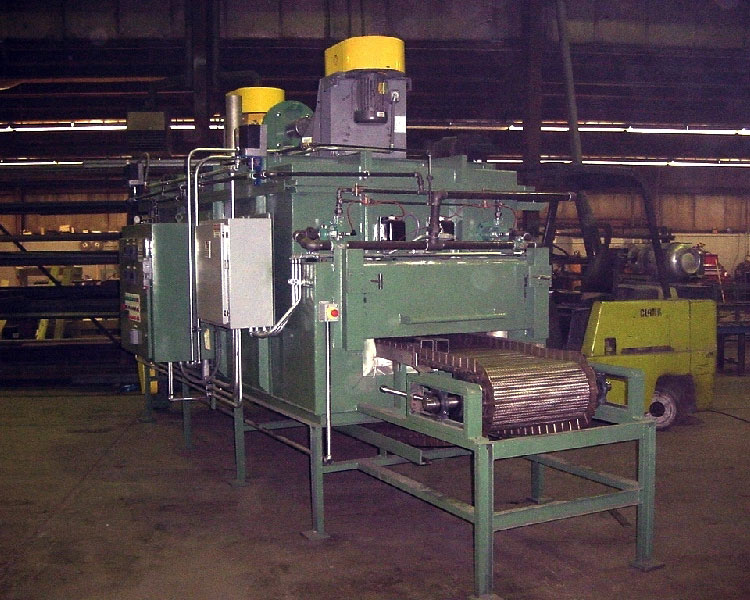
belt furnacesUpton manufactures continuous belt type furnaces in either electric or gas fired heating systems. The design of the heating systems provide for shielding of the loads from the detrimental effects of direct radiant heat or flame impingement while promoting efficient uniform heating of the loads.

Electric Heating Systems

Electric furnaces employ various styles of resistance type electric heaters to maintain the integrity of the furnace atmosphere and thermal efficiencies. Heaters can be supplied as either standard open resistance wire type, or bayonet/radiant tube style based on the specific furnace application, intended atmosphere and/or customer preference. SCR power controllers with control panel door mounted diagnostics displays are standard for Upton furnaces, with optional PLC and PC systems integration available. Heating systems are factory prewired to meet NEC and NFPA standards where applicable, and all equipment is factory tested prior to shipment.

Gas Firing Systems

Gas fired furnaces employ either direct gas firing or radiant tube style gas firing burners to maintain the integrity of the furnace atmosphere. Sealed burner systems can be supplied as either standard tube firing or single end recuperative type based upon customer preference. Solid-state flame supervision systems with panel door mounted diagnostics displays are standard for Upton furnaces, with optional PLC and PC systems integration available. Combustions systems are factory prepiped to meet FM, IRI, and NFPA standards where applicable, and all equipment is factory tested prior to shipment.

Thermal Recirculation Systems

Upton furnaces utilize alloy construction cartridge type fans for recirculation of the furnace atmosphere, promoting close tolerance temperature uniformities. Recirculation fans are located within a stainless steel plenum positioned in the top of the furnace heating chamber, integrated with the gas firing or electric heating system, to eliminate potential of direct heating of the workloads. Lateral sidewall ductwork is employed for introduction of the furnace atmosphere into the workzone beneath the workload, with recirculation and redistribution through the fan plenum inlet.

Variable Speed Belt Drive Systems

Continuous belt type furnaces employ solid state variable speed drives to allow for flexibility in part processing rates. Furnaces are designed with positive chain or direct belt style drives for smooth tracking and alignment during operation.

Custom Designed & Engineered

Our in-house engineering and manufacturing allows Upton to custom design furnaces and systems to a customers process and specification requirements, rather than attempting to provide to you standard pre-design equipment, as some of our competitors would attempt to do. Follow-up technical services are available for all Upton thermal process systems.

Our Engineered Thermal Solutions will allow for flexibility in your manufacturing productivity.

Bell Furnaces

bell furnaces

Electrically Heated or Gas Fired

bell furnacesUpton manufactures lift off bell type furnaces in either electric or gas fired heating systems. The design of the heating systems provide for shielding of the loads from the detrimental effects of direct radiant heat or flame impingement while promoting efficient uniform heating of the loads.

Electric Heating Systems

Electric furnaces employ various styles of resistance type electric heaters to maintain the integrity of the furnace atmospheres and thermal efficiencies. Heaters can be supplied as either standard open resistance wire type, or bayonet/radiant tube style based on the specific furnace application, intended atmosphere and/or customer preference. SCR power controllers with control panel door mounted diagnostics displays are standard for Upton furnaces, with optional PLC and PC systems integration available. Heating systems are factory prewired to meet NEC and NFPA standards, and all equipment is factory tested prior to shipment.

Gas Firing Systems

Gas fired furnaces employ either direct gas firing or radiant tube style gas firing burners to maintain the integrity of the furnace atmosphere. Sealed burner systems can be supplied as either standard tube firing or single end recuperative type based upon customer preference. Solid state flame supervision systems with panel door mounted diagnostics displays are standard for Upton furnaces, with optional PLC and PC systems integration available. Combustions systems are factory prepiped to meet FM, IRI, and NFPA standards where applicable, and all equipment is factory tested prior to shipment.

Thermal Recirculation Systems

Upton furnaces utilize alloy construction cartridge type fans for recirculation of the furnace atmosphere, promoting close tolerance temperature uniformities. Recirculation fans are located within a stainless steel plenum positioned in the top of the furnace heating chamber, integrated with the gas firing or electric heating system, to eliminate potential of direct heating of the workloads. Lateral sidewall ductwork is employed for introduction of the furnace atmosphere into the workzone beneath the workload, with recirculation and redistribution through the fan plenum inlet.

Electro/Mechanical Type Lifting System

Upton lift off type furnaces employ a rigid floor loading superstructure design with positive guides for smooth operation. The lifting mechanism is designed with an electro/mechanical type system utilizing ball screw actuators.

Custom Designed & Engineered

Our in-house engineering and manufacturing allows Upton to custom design furnaces and systems to a customers process and specification requirements, rather than attempting to provide to you standard pre-design equipment, as some of our competitors would attempt to do. Follow-up technical services are available for all Upton thermal process systems.

Our Engineered Thermal Solutions will allow for flexibility in your manufacturing productivity.

Externally Heated Salt Pot Furnaces

Externally Heated Salt Pot Furnaces

Upton Externally Heated Steel Lined Salt Bath Furnaces

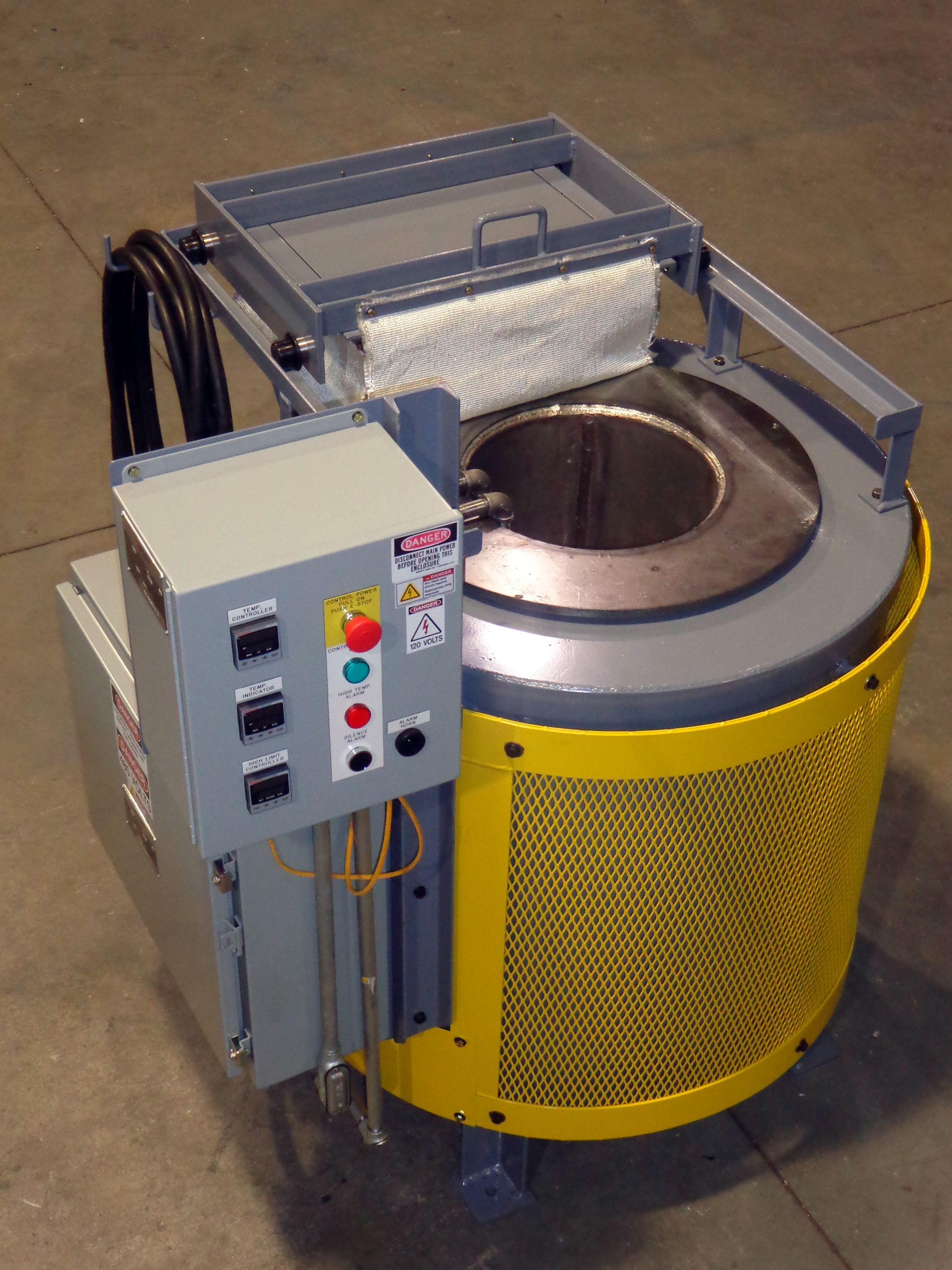
Upton manufactures externally heated, inner lined salt bath furnaces designed for various applications. These furnaces can be constructed with a carbon or stainless steel pot liner materials as operating conditions warrant.

Externally Heating Method

The external heating method of these furnaces can be either electric by use of resistance type heating elements or gas fired utilizing the unique Upton “Hurricane” design which incorporates tangentially firing burners designed to minimize flame impingement to the inner pot salt containment pot. Combustion systems can be FM or IRI rated.

Upton Externally Heated Salt Bath Furnace Applications

Upton externally heated salt bath furnaces can be employed for service in a variety of high and low temperature, ferrous and non-ferrous thermal processing such as tempering, case hardening, caustic bath cleaning, paint stripping, solution treating of aluminum and vinyl/plastic curing. Externally heated furnace operation is ideally suited for intermittent service duties.

Custom Designed and Engineered

Our in-house engineering and manufacturing allows Upton to custom design furnaces and systems to a customers process and specification requirements, rather than attempting to provide to you standard pre-design equipment, as some of our competitors would attempt to do. Follow-up technical services are available for all Upton thermal process systems.

Our Engineered Thermal Solutions will allow for flexibility in your manufacturing productivity.

Internally Heated Salt Bath Furnaces

Internally Heated Salt Bath Furnaces

Internally Heated Salt Bath FurnacesUpton Internally Heated Steel Lined Salt Bath Furnaces

Upton manufactures internally heated, metallic inner lined salt bath furnaces designed for use with non-chloride based salt applications. These furnaces can be constructed from carbon or stainless steel materials as operating conditions warrant.

Immersion Heating Method

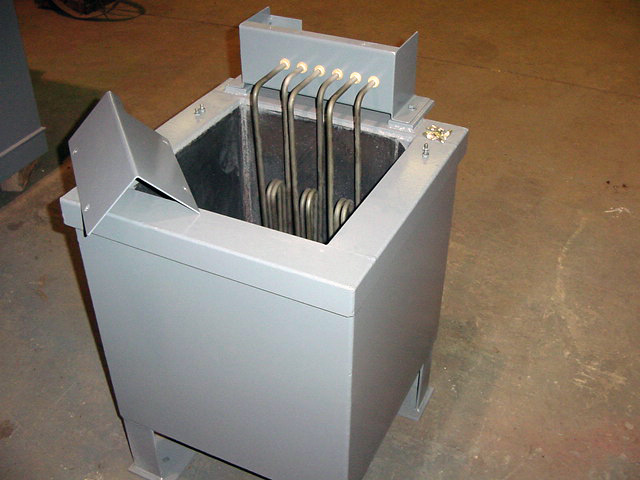
The immersion heating method of these furnaces can be electric by use of immersion heaters for lower temperature applications, or electrodes/transformer operation as either air or water cooled at elevated temperatures. Gas fired units employ FM or IRI type radiant tube firing.

Thermal Process Applications

Upton Internally Heated Salt Bath Furnaces can be employed for service in a variety of high and low temperature, ferrous and non-ferrous thermal processing such as tempering, case hardening, caustic bath cleaning, paint stripping, dip brazing solution treating of aluminum and vinyl/plastic curing.

Custom Designed and Engineered

Our in-house engineering and manufacturing allows Upton to custom design furnaces and systems to a customers process and specification requirements, rather than attempting to provide to you standard pre-design equipment, as some of our competitors would attempt to do. Follow-up technical services are available for all Upton thermal process systems.

Our Engineered Thermal Solutions will allow for flexibility in your manufacturing productivity.

Ceramic Salt Bath Furnaces

ceramic salt bath furnaces

Maximum Work Space with Minimum Bath Area

Through the unique submerged electrode placement design, the electrodes do not occupy any portion of the bath. Only the active face comes in contact with the bath. This single exposed electrode surface minimizes bath size and increases electrode life over immersed electrode designs, while eliminating air/salt interface corrosion attack.

Convection Circulation Currents

The Upton submerged electrode placement gives more uniform bath temperatures and salt movement by natural convection currents. Heated salts rise in the bath while cooler salts fall to the electrode area for reheating.

Engineered Triple Ceramic Refractory Wall Construction

The Upton triple refractory wall construction is designed so that the temperature gradient through the wall will cause any salt penetration through the hardbrick bath liner to solidify within the intermediate castable refractory materials. This engineered refractory construction design limits initial salt absorption into the walls from 5 to 8 percent of bath volume, as opposed to 140 to 150 percent absorption experienced by some furnace designs using dual refractory wall construction with steel outer shells.

This engineered triple wall construction allows for the furnace to become a monolithic structure, sealing the refractories and minimizing the potential of outer wall distortion or furnace leakage.

Electrode Placements Give Clear Working and Cleaning Area

The Upton submerged electrode design creates a clear bath volume free of any protruding obstructions, allowing for maximum working area while providing for ease of bath maintenance.

Upton Ceramic Salt Bath Furnace Designs

Upton Ceramic Salt Bath Furnaces can be employed for service in a variety of ferrous and non-ferrous thermal processing in either air cooled or water cooled electrode and transformer designs.

Thermal Process Applications

Upton salt bath furnaces are used for various high temperature ferrous and non-ferrous thermal processing applications such as neutral hardening, Austempering, Marquenching, tempering, case hardening, and dip brazing.

Custom Designed and Engineered

Our in-house engineering and manufacturing allows Upton to custom design furnaces and systems to a customers process and specification requirements, rather than attempting to provide to you standard pre-design equipment, as some of our competitors would attempt to do. Follow-up technical services are available for all Upton thermal process systems.

Our Engineered Thermal Solutions will allow for flexibility in your manufacturing productivity.

ceramic salt bath furnaces

high heat furnace

Videos

Furnace Roller Cover Open

Furnace Roller Cover Close


Pit Type Furnaces

pit type furnaces

Electrically Heated or Gas Fired

Pit Type FurnacesUpton manufactures pit type furnaces in either electric or gas fired heating systems. The design of the heating systems provide for shielding of the loads from the detrimental effects of direct radiant heat or flame impingement while promoting efficient uniform heating of the loads.

Uniformity of Temperatures

Stainless steel retorts employ bottom mounted circulation fans with atmosphere inlet to ensure temperature uniformity and atmosphere integrity.

Custom Designed & Engineered

Our in-house engineering and manufacturing allows Upton to custom design furnaces and systems to a customers process and specification requirements, rather than attempting to provide to you standard pre-design equipment, as some of our competitors would attempt to do. Follow-up technical services are available for all Upton thermal process systems.

Our Engineered Thermal Solutions will allow for flexibility in your manufacturing productivity.